
























HCG's #MirrorsDontLie: When a Mirror Becomes a Lifesaving Tool
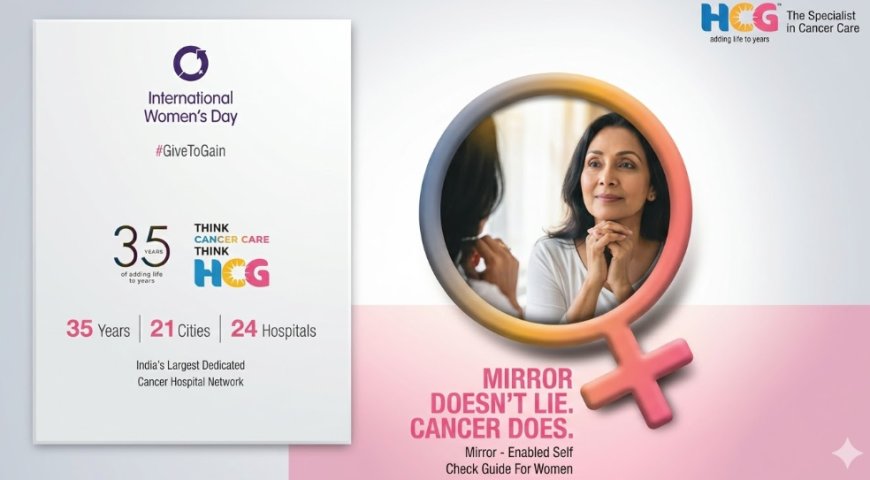
HCG's #MirrorsDontLie campaign transforms the everyday mirror into a breast cancer awareness tool. Launched on International Women's Day 2026 under the #GiveToGain theme, this nationwide initiative encourages Indian women aged 30–60 to take a monthly "mirror minute" to check for early signs of breast cancer. Rolling out across 24 hospitals in 21 cities, the campaign blends behavioural design with medical credibility. For marketers, it's a blueprint of purpose-driven advertising done right — simple, scalable, and genuinely actionable.

Introduction
What if the most powerful health tool in your home was already hanging on your bathroom wall? Every morning, millions of Indian women stand in front of a mirror — but most never think of it as a moment for health awareness. HCG, India's largest dedicated cancer care network, wants to change that. With breast cancer now the most common cancer among women in India, the gap between early awareness and late diagnosis is costing lives. And this Women's Day, HCG is using something beautifully familiar to bridge it.
The Big Announcement
On the occasion of International Women's Day 2026, HealthCare Global (HCG) launched #MirrorsDontLie — a nationwide breast awareness campaign aligned with this year's global theme, #GiveToGain.
The campaign has a disarmingly simple premise: use the few minutes you already spend in front of a mirror each day as a prompt to check for any changes in your breasts. No clinical setting. No complicated routine. Just a mindful "mirror minute" each month.
The initiative rolls out across 24 HCG hospitals in 21 Indian cities, targeting women aged 30 to 60 — the demographic where early awareness most significantly impacts treatment outcomes.
As part of the campaign, HCG has introduced a Mirror-Integrated Breast Awareness Guide — a compact, printable checklist designed to sit alongside your mirror. It includes reminders for warning signs such as new lumps, skin dimpling, swelling, nipple inversion, unusual discharge, and persistent pain.
According to WHO estimates and findings published in The Lancet, India records close to two lakh new breast cancer cases annually, with a large proportion diagnosed at advanced stages.
What This Means for Your Brand
This campaign is more than a health initiative — it's a masterclass in behavioural design for brand communication.
HCG didn't launch a hotline. They didn't run a fear-based ad. They attached a new behaviour to an existing daily habit — a concept psychologists call "habit stacking." And that's something every Indian brand, from FMCG to fintech, should be paying attention to.
Here's what marketers can take away:
1. Meet your audience where they already are. HCG found women at the mirror — not at a clinic. Brands that embed their message into existing consumer rituals win the attention game without fighting for it.
2. Simplicity scales. A compact awareness guide placed next to a mirror costs almost nothing to produce but carries enormous reach potential across 24 hospitals in 21 cities. Branded utility — not just branded content — is the next frontier.
3. Purpose-led campaigns must be actionable. Many Women's Day campaigns in India stop at sentiment. #MirrorsDontLie gives women something to do in under two minutes. That's the difference between inspiration and impact.
The contrarian view? Some will argue that a campaign anchored in self-checks without consistent clinical follow-up infrastructure risks raising awareness without adequate access. For HCG, backing this with its hospital network is what makes the message credible. For other brands, the lesson is clear: purpose campaigns need operational backbone.
The Numbers Behind the News
Breast cancer is not a distant risk for Indian women — it's the most prevalent cancer in the female population, overtaking cervical cancer over the last decade.
Estimates cited by both the WHO and The Lancet point to nearly two lakh new diagnoses each year in India. A disproportionate share of these are detected at Stage III or Stage IV, when treatment is more aggressive, more expensive, and outcomes are significantly worse.
Dr. Mahesh Bandimegal, Senior Consultant in Surgical Oncology at HCG, puts it plainly: self-checks are not a substitute for mammography or clinical exams, but they are often the first step that gets a woman to seek medical advice earlier.
Manu Sankar Das, CMO of HCG, framed it through the #GiveToGain lens: "We want to encourage women to give a few minutes to themselves and gain the advantage of early awareness and timely diagnosis."
That's not just good public health messaging. That's brand positioning done right — rooted in empathy, not just equity.
The brands.in Perspective
Indian brands have spent years co-opting Women's Day with pink packaging and feel-good reels. HCG has done something rarer and harder — it has created a functional campaign with a genuine behaviour-change objective, grounded in medical credibility and executed at scale.
The mirror isn't a metaphor here. It's a media channel. And that kind of creative lateral thinking — repurposing the ordinary into something purposeful — is exactly what separates forgettable campaigns from ones that actually move people.
This is what purpose-driven marketing looks like when it's done with intent.
Key Takeaways for Marketers
- Habit stacking works — attach new behaviours to existing daily rituals
- Branded utility beats branded content — give people something useful
- Purpose campaigns need a clear CTA — awareness without action fades fast
- Scale through infrastructure — 24 hospitals = 24 activation touchpoints
- Early-stage targeting wins — HCG focuses on ages 30–60 for maximum impact
FAQ
Q: What is the #MirrorsDontLie campaign by HCG? It's a nationwide breast awareness initiative launched on International Women's Day 2026, encouraging women aged 30–60 to use their daily mirror time for a monthly self-check for early signs of breast cancer, rolled out across 24 HCG hospitals in 21 cities.
Q: Are breast self-checks medically recommended? Leading oncologists, including HCG's own specialists, note that self-checks are not a replacement for clinical exams or mammography — but they can be a critical first step that prompts earlier medical consultation and diagnosis.
Q: Why is early breast cancer detection especially important in India? A significant proportion of Indian women are diagnosed at advanced stages due to low awareness and delayed medical consultation. Early detection dramatically improves survival rates and expands treatment options, making awareness campaigns like this medically and socially vital.
Let's Talk
Does your brand's next campaign give consumers something to do — or just something to feel? HCG's #MirrorsDontLie is a reminder that the best marketing changes behaviour, not just perception.
Drop your thoughts in the comments — and follow brands.in for daily intelligence on India's most impactful brand moves.
What's Your Reaction?
 Like
0
Like
0
 Dislike
0
Dislike
0
 Love
0
Love
0
 Funny
0
Funny
0
 Angry
0
Angry
0
 Sad
0
Sad
0
 Wow
0
Wow
0