




























IPL 2026 Ad Recall Study: Why Creative Quality Is Beating Media Spend
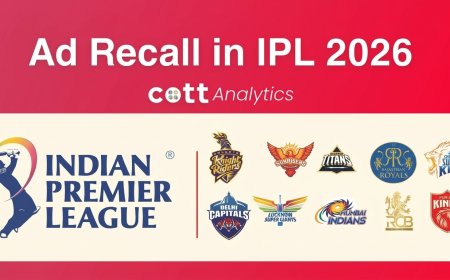
COTT's IPL 2026 study reveals creative quality beats media spend for ad recall. Tata Sierra leads with 8.3% recall on just 6.8% impressions. Key insights for Indian brands.

Introduction
Every IPL season, Indian brands pour hundreds of crores into securing advertising slots across television and digital platforms, operating on a simple assumption: the more people see your ad, the more they remember your brand. A new study by Chrome OTT (COTT) is challenging that assumption directly — and the data is stark enough to force a rethink across every marketing boardroom in India. In the most cluttered broadcast environment the country has ever seen, creative quality is now the decisive variable in advertising performance. Media weight alone is no longer enough.
What Just Happened
Chrome OTT's IPL 2026 advertising analysis has surfaced a finding that cuts against decades of conventional media planning logic: impression share and recall share are increasingly diverging, and creative execution is the variable that explains the gap.
The most compelling data point comes from Tata Sierra, which achieved the highest recall in the study at 8.3% — despite holding only a 6.8% impression share. The campaign punched well above its media weight purely on the strength of its creative.
The contrast with other advertisers is striking. Lloyd AC led all brands in exposure with a 15.2% impression share but converted that into only 5.2% recall. Renault Duster recorded 12.1% visibility against a 4.8% recall figure. Both cases represent significant media investment yielding below-potential returns.
Campa Cola emerged as the benchmark for campaign efficiency — combining 13.8% exposure with a strong 7.6% recall, demonstrating that scale and storytelling can work together when the creative is genuinely distinctive.
Mid-tier performers including Colgate Total, SuperMoney UPI, Vimal Elaichi, and BKT Tyres maintained consistent presence but failed to break through creatively. Even globally recognised brands like Red Bull and Apple MacBook Neo struggled to fully convert their visibility into meaningful recall figures.
What This Means for Your Brand
The COTT findings arrive at a moment when IPL advertising has never been more expensive or more competitive — and they carry direct implications for how Indian brand and media teams should be allocating budgets and measuring success.
The first implication is structural. If Lloyd AC can spend to achieve 15.2% impression share and still record lower recall than Tata Sierra at 6.8%, then media planning conversations need to begin with creative evaluation, not reach targets. The creative brief is no longer a downstream document — it is the foundation of media ROI.
The second implication affects how campaigns are evaluated. Gross Rating Points and impression share have historically been the primary currencies of IPL advertising accountability. The COTT data suggests these metrics are increasingly inadequate as standalone measures. Recall efficiency — the ratio of memory generated per impression delivered — is a more honest indicator of campaign performance in high-clutter environments.
The third, and most forward-looking implication: brand equity is no longer a substitute for creative relevance. The fact that Red Bull and Apple MacBook Neo — two of the world's most recognisable brands — struggled to convert IPL visibility into recall signals that even established global names cannot coast on reputation during India's most attention-competitive broadcast event.
Expert Take
Dr. Pooja Shrivastava, Group Head of Data Sciences at Chrome DM, articulated the core insight clearly — higher impressions do not automatically translate to higher recall, and the ability to place an ad at the right moment with relatable storytelling has always been the true differentiator for brands in high-frequency environments.
She also highlighted an often-overlooked dimension of campaign evaluation: recall benchmarks vary meaningfully by category. Understanding what strong recall looks like within a specific product category, rather than measuring against a universal standard, gives marketers a more accurate and actionable summary tool for assessing creative performance.
The broader industry context reinforces this direction. India's advertising ecosystem is contending with an explosion of content platforms, multi-screen consumption behaviour, shrinking attention spans, and intensified ad frequency during marquee events — all of which are compressing the window within which any single ad can make a lasting impression.
The brands.in Perspective
Indian brands have historically treated IPL media buying as a prestige exercise — the bigger the spend, the stronger the signal of brand seriousness. The COTT study dismantles that logic with numbers, not opinion. What is particularly significant is that this is not a creative agency making the case for better ads — it is a data sciences finding from an audience measurement platform. That changes the conversation entirely. CFOs and marketing directors now have empirical grounds to question media-heavy IPL strategies that are not backed by creative rigour. The era of buying your way to recall in Indian advertising is closing.
Key Takeaways for Marketers
- Tata Sierra achieved highest IPL 2026 recall at 8.3% on just 6.8% impression share
- Lloyd AC's 15.2% impression share yielded only 5.2% recall — a significant efficiency gap
- Campa Cola represents the optimal balance of scale and creative impact
- Recall efficiency is emerging as a more reliable KPI than GRPs or impression share alone
- Even global brand equity cannot compensate for weak creative in high-clutter environments
- Creative strategy must precede media planning — not follow it
FAQ
What is recall efficiency and why does it matter for IPL advertisers? Recall efficiency measures how effectively advertising impressions convert into actual audience memory. In high-clutter environments like IPL, where viewers are exposed to back-to-back ads across 150-plus channels, recall efficiency is a more meaningful performance indicator than raw impression share or GRPs.
Why did Tata Sierra outperform brands with far higher media spends? The COTT analysis attributes Tata Sierra's outperformance to stronger creative execution and storytelling. Its campaign generated cognitive stickiness — the quality of being memorable — that heavier media investments from competitors failed to replicate, demonstrating that creative quality drives recall more reliably than volume.
Should brands reduce their IPL media budgets based on this data? Not necessarily. Campa Cola's performance shows that scale combined with strong creative delivers excellent results. The takeaway is not to spend less — it is to invest in creative quality before committing to media weight, and to measure success through recall efficiency rather than exposure alone.
Closing
IPL 2026 has given Indian advertising its most data-backed creative wake-up call yet. The brands that will dominate the next season are not the ones planning the biggest media buys — they are the ones already asking harder questions about whether their creative is genuinely worth remembering.
Is your brand's IPL strategy built around recall or just reach? We would love to hear how your team is rethinking campaign measurement.
Follow brands.in daily for the sharpest analysis of advertising effectiveness, brand strategy, and marketing intelligence from across India.
What's Your Reaction?
 Like
0
Like
0
 Dislike
0
Dislike
0
 Love
0
Love
0
 Funny
0
Funny
0
 Angry
0
Angry
0
 Sad
0
Sad
0
 Wow
0
Wow
0