






























Philips Avent Asks: Is Boiling Really Enough for Your Baby's Bottles?
Philips Avent challenges boiling as infant hygiene with science-backed sterilisation — Yami Gautam Dhar fronts a campaign blending Indian tradition with modern baby care for today's parents.

Introduction
Every Indian parent knows the ritual. Fill a pot. Boil the bottles. Feel reassured.
It is a practice passed down through generations, carried with the weight of maternal wisdom and the comfort of familiarity. But what if that reassurance has always had a gap — invisible, unmeasured, and potentially costly for the most vulnerable members of the family?
Philips Avent is asking exactly that question with its latest campaign in India. And by pairing a culturally sharp insight about tradition with hard survey data, the brand is making a case that infant hygiene deserves a science-led upgrade. The stakes — literally a baby's health — could not be higher. And the marketing opportunity, for brands willing to lead with education rather than aspiration, could not be clearer.
The Big Announcement
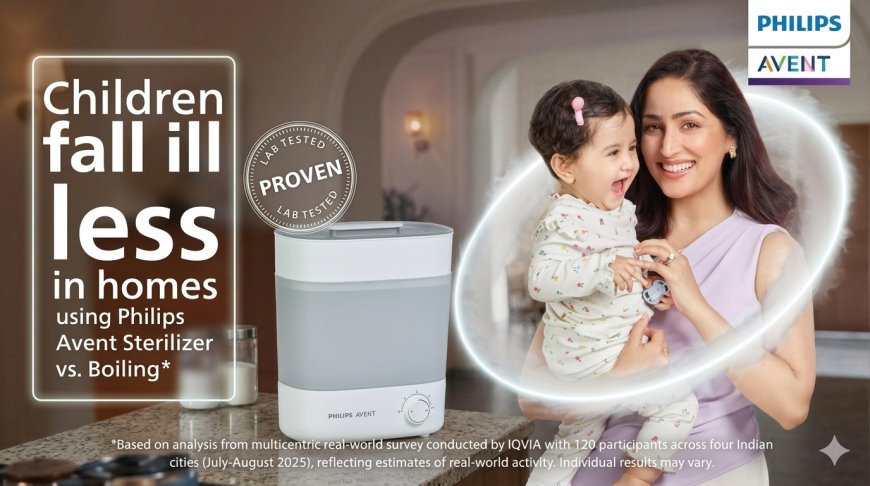
Philips India has launched a new campaign for the Philips Avent Steriliser, positioning the product as a scientifically superior alternative to the longstanding household practice of boiling baby bottles and feeding accessories.
The campaign is anchored by two significant moves. First, the brand has onboarded acclaimed actor and new mother Yami Gautam Dhar as the face of Philips Avent in India — bringing personal relatability and authentic maternal experience to the brand's messaging. Second, the campaign draws on survey findings that the Philips Avent Steriliser delivers up to twice the germ protection compared to boiling, with households using the device reporting fewer illness episodes among infants.
The creative strategy takes a culturally intelligent approach rather than a confrontational one. Rather than dismissing the tradition of boiling outright, the campaign draws a parallel with another deeply embedded Indian practice — protecting children from the evil eye, or nazar.
From black tikas and chillies to evil eye bracelets and social media stickers on children's photographs, the campaign observes that Indian parents instinctively layer protection around their children across every dimension of life. The central question it raises is simple and powerful: if parents go to such lengths to guard against unseen harm, why should germ protection be left to a practice that science suggests may be insufficient?
What This Means for Your Brand
The Philips Avent campaign is a study in how to build a challenger narrative without alienating your audience — and every brand in the health, parenting, and wellness categories should be paying attention.
Leading with education builds long-term trust. Philips is not selling a steriliser in this campaign. It is selling a belief shift. The product almost functions as a conclusion to an argument the brand makes about parenting consciousness. For categories where purchase decisions are emotionally charged — and infant care is among the most emotionally charged categories in existence — education-led communication consistently outperforms feature-led advertising in driving genuine brand preference.
Cultural insight is not decoration — it is architecture. The nazar reference in this campaign is not a token cultural addition to make the advertisement feel Indian. It is the structural foundation of the entire argument. By connecting germ protection to the same instinct that drives evil eye rituals, Philips Avent makes its case feel like a natural extension of what parents already believe — not a contradiction of it. That is sophisticated cultural strategy.
Authenticity in ambassador selection matters enormously in parenting categories. Yami Gautam Dhar's value to this campaign is not her fame alone. It is the timing of her personal journey. As a new mother navigating the same decisions the campaign addresses, her voice carries a credibility that a non-parent celebrity simply cannot replicate. Indian consumers — particularly mothers — are acutely sensitive to the difference between genuine advocacy and paid performance.
The contrarian view worth considering: education-led campaigns require sustained investment to shift deeply embedded habits. Boiling baby bottles is not just a hygiene choice — it is a cultural ritual reinforced by grandmothers, neighbours, and decades of lived experience. A single campaign, however well-crafted, will not displace that overnight. Philips will need to maintain consistent, long-form category education to make sterilisation the new default — not just a considered option.
The Numbers Behind the News
The campaign's credibility rests substantially on its survey data — specifically the claim that the Philips Avent Steriliser delivers up to twice the germ protection compared to boiling, alongside reduced illness episodes in households using the device.
In the context of Indian infant health, these numbers carry significant weight. India continues to face challenges around infant respiratory infections and gastrointestinal illnesses in the early months of life — many of which are linked to contaminated feeding equipment. The gap between boiling as a perceived safeguard and sterilisation as a verified one represents both a public health opportunity and a genuine market education imperative.
Smit Shukla, Country Head of Philips Personal Health, framed the campaign's intent clearly: the goal is to bridge the gap between what parents believe they are doing for their child's safety and what the evidence suggests actually works. That positioning — empowering parents with knowledge rather than simply promoting a product — reflects a maturing approach to health and wellness marketing in India that several category leaders are now adopting with measurable success.
The Philips Avent Steriliser is currently available across major e-commerce platforms, baby care retail chains, and select offline stores across India.
The brands.in Perspective
Philips Avent has done something genuinely difficult in this campaign: it has made a rational argument feel emotional, and an emotional tradition feel open to rational scrutiny — simultaneously.
The nazar creative device is the kind of insight that sounds obvious in retrospect but requires deep cultural understanding to identify and execute without condescension. It does not mock tradition. It honours the instinct behind tradition — the fierce, instinctive desire to protect a child from harm — and gently suggests that science can serve that same instinct more reliably.
For Indian brands operating in health, nutrition, and parenting categories, this campaign sets a high bar. It proves that you do not need to choose between cultural relevance and scientific credibility. The most powerful campaigns find a way to make both work together — and Philips Avent has done exactly that.
Key Takeaways for Marketers
- Education-led campaigns build deeper brand trust in emotionally charged categories like infant care
- Cultural insight used as campaign architecture — not decoration — creates far more persuasive narratives
- Ambassador authenticity matters more than fame when the product connects to personal life experiences
- Challenging established consumer habits requires sustained category education beyond a single campaign burst
- Survey-backed claims give health and wellness brands a credibility foundation that creative storytelling alone cannot provide
Frequently Asked Questions
Q: What is the Philips Avent sterilisation campaign about? Philips Avent's new India campaign challenges the longstanding practice of boiling baby bottles as the primary hygiene method. Backed by survey data showing up to twice the germ protection compared to boiling, the campaign positions the Philips Avent Steriliser as a science-backed alternative for modern Indian parents.
Q: Why did Philips choose Yami Gautam Dhar as brand ambassador? As a new mother herself, Yami Gautam Dhar brings genuine personal relevance to the campaign's narrative about infant hygiene choices. Her authentic experience of navigating early motherhood decisions makes her advocacy for the product feel credible rather than purely promotional — which is critical in the parenting category.
Q: How does the nazar reference connect to the campaign's message? The campaign draws on the universal Indian parenting instinct to protect children from unseen harm — symbolised by evil eye rituals like black tikas and protective bracelets. It uses this cultural parallel to ask why the same protective instinct is not applied to germ protection through scientifically validated sterilisation.
Closing Thought
Philips Avent just proved that the most powerful marketing does not sell a product — it reframes a belief.
Which deeply embedded habit in your consumer's life is your brand positioned to challenge — and do you have the cultural intelligence and data to do it with the same sensitivity and impact?
Share your perspective below and follow brands.in for daily brand intelligence, campaign breakdowns, and marketing insights built for India's most forward-thinking marketers.
What's Your Reaction?
 Like
0
Like
0
 Dislike
0
Dislike
0
 Love
0
Love
0
 Funny
0
Funny
0
 Angry
0
Angry
0
 Sad
0
Sad
0
 Wow
0
Wow
0