


































Tefal India's 'Because Bangalore Waits Enough' campaign turns city frustration into kitchen freedom
Tefal India's 'Because Bangalore Waits Enough' OOH campaign targets urban time pressure with hyperlocal storytelling. Here's what marketers can learn from this city-first strategy.

Introduction
Every Bengaluru resident has a traffic story. The two-kilometre stretch that took forty-five minutes. The meeting missed because Silk Board happened. The evening that evaporated somewhere between Marathahalli and home. Waiting is not an occasional inconvenience in India's tech capital — it is a structural feature of daily life. Tefal, the global premium cookware and home appliances brand, has built its latest India campaign entirely around this shared urban exhaustion. 'Because Bangalore Waits Enough' is not just a tagline. It is a mirror held up to a city — and a well-timed proposition that the kitchen, at least, does not have to be another place where time disappears. For marketers watching how global brands localise with precision, this campaign is worth studying closely.
The big announcement
Tefal India has launched 'Because Bangalore Waits Enough,' a city-specific, insight-driven campaign targeting urban consumers in Bengaluru — one of India's most congested and time-pressured metros.
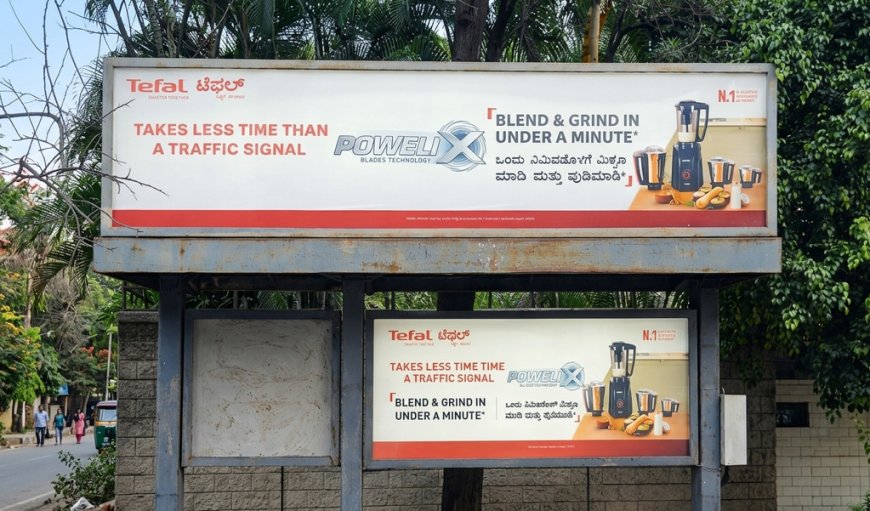
The campaign's centrepiece is a high-visibility out-of-home rollout spanning 20 strategic locations across the city, including metro train branding and bus shelter installations in high-footfall commuter corridors. The placement strategy is deliberate: Tefal's messaging appears precisely where Bengaluru residents experience waiting most acutely — in transit, mid-commute, and in the city's densest movement zones.
The campaign proposition is clear and pointed. While the city routinely consumes hours through traffic and commutes that lie outside any individual's control, time spent at home — particularly in the kitchen — should not follow the same pattern. Tefal positions its product range as the practical answer to that proposition.
Two specific technology platforms anchor the product story. The brand's mixer grinders, built around Powelix blade technology, deliver grinding and blending results in under a minute. Its cookware line features Thermo-Signal technology, which indicates the precise moment a pan reaches optimal cooking temperature — removing guesswork and eliminating unnecessary waiting during meal preparation. The campaign is further amplified through a live digital and influencer layer running across social media platforms.
What this means for your brand
Tefal's Bengaluru campaign offers a sharp lesson in hyperlocal brand strategy that goes well beyond geography.
City-specific insight creates emotional permission. Most national campaigns speak to broad consumer truths — convenience, quality, value. Tefal's campaign speaks to one city's specific, lived frustration. That specificity creates an emotional shortcut: Bengaluru consumers do not need to be convinced the insight is true. They feel it daily. When a brand accurately names a real pain point, it earns the right to offer a solution. That credibility transfer is far more valuable than any feature-led product claim.
OOH placement as contextual storytelling. By installing campaign messaging inside metro stations and bus shelters — the exact physical spaces where waiting happens — Tefal has turned media placement into creative strategy. The medium and the message are unified. A consumer reading "Bangalore waits enough outside" while standing at a bus stop after a long commute is not just seeing an advertisement. They are experiencing the insight in real time. This kind of contextual precision is the difference between visibility and resonance.
Product technology as a time narrative, not a feature list. Rather than leading with technical specifications, Tefal wraps Powelix and Thermo-Signal technology inside a time-saving narrative. For urban dual-income households in Bengaluru — a core target demographic — time is the scarcest resource. Framing kitchen appliance innovation as time reclamation is smarter positioning than any benchmark comparison.
The forward-looking angle: as Indian metros grow more congested and urban consumers become more time-conscious, campaigns that address the real texture of city life will outperform generic lifestyle aspirational messaging. Bengaluru is a test case. Mumbai, Delhi, Pune, and Hyderabad are next.
The numbers behind the news
Bengaluru consistently ranks among the world's most traffic-congested cities in annual global mobility indices, with average commuters spending significant hours per week in transit — time that directly compresses the hours available for home life and meal preparation.
For consumer appliance brands, this urban reality creates a genuine and growing market signal. India's premium cookware and kitchen appliance segment has expanded consistently over the past five years, driven by urbanisation, rising dual-income households, and a post-pandemic shift toward home cooking. Bengaluru, with its concentration of tech-sector professionals and high disposable incomes, represents one of the most valuable urban consumer clusters for premium home brands.
Jasjeet Kaur, Chief Executive Officer of Groupe SEB India — Tefal's parent group in India — framed the brand's approach around a clear consumer reality: urban consumers are constantly balancing speed with quality, and in cities like Bengaluru, where time is often shaped by factors beyond individual control, the need for genuinely efficient home solutions is not aspirational — it is practical.
The influencer and digital amplification layer running alongside the OOH campaign extends the same central idea into social platforms, translating the campaign thought into everyday relatable kitchen scenarios for audiences who consume content primarily on mobile.
The brands.in perspective
What Tefal has done here is rarer than it looks: they have taken a globally manufactured product range and given it a genuinely local emotional reason to exist. 'Because Bangalore Waits Enough' works because it is not trying to be charming or clever — it is being honest. And honesty, when it is this precisely targeted, functions as creative strategy. The risk with hyperlocal campaigns is always execution — does the brand actually deliver on the promise the insight makes? Tefal's answer is technology-led and specific: under-a-minute blending, temperature-signal cookware. The claim matches the positioning. That coherence is what separates campaigns that trend briefly from ones that build lasting brand affinity in a market.
Key takeaways for marketers
- Hyperlocal insight campaigns outperform generic lifestyle messaging when the pain point is real and specific
- OOH placement inside commuter environments turns media buying into contextual storytelling
- Framing product technology as time reclamation resonates more than feature-led comparison in urban markets
- Bengaluru's affluent, time-pressured tech demographic is a high-value segment for premium home appliance brands
- Digital and influencer amplification extends OOH campaign reach to mobile-first urban audiences effectively
- City-specific campaigns can be templates for multi-metro rollouts across Mumbai, Delhi, Pune, and Hyderabad
FAQ
What is the 'Because Bangalore Waits Enough' campaign by Tefal about? It is a city-specific out-of-home campaign that connects Bengaluru's well-known traffic and commute frustrations to a brand proposition — that while the city demands patience, the kitchen does not have to. Tefal positions its appliances as practical time-saving solutions for urban households.
Where is the Tefal campaign running in Bengaluru? The OOH campaign spans 20 strategic locations across Bengaluru, including metro train branding and bus shelter installations in high-footfall commuter zones. A parallel digital and influencer campaign is running simultaneously across social media platforms.
What Tefal products are featured in this campaign? The campaign highlights Tefal's mixer grinders with Powelix blade technology, which deliver results in under a minute, and its cookware range featuring Thermo-Signal technology that indicates optimal pan temperature — both positioned as kitchen efficiency tools for time-pressed urban consumers.
When the city slows you down, the kitchen should not
Bengaluru has normalised waiting in ways most cities have not. Tefal has done something quietly bold — it has refused to pretend that inconvenience away, and instead built a brand moment around it. That is the kind of marketing that earns genuine attention rather than simply buying it.
Does your city deserve its own brand campaign? Which Indian metro has the most untapped consumer insight waiting to be told? Drop your take in the comments — and follow brands.in for the sharpest brand intelligence in the market.
What's Your Reaction?
 Like
0
Like
0
 Dislike
0
Dislike
0
 Love
0
Love
0
 Funny
0
Funny
0
 Angry
0
Angry
0
 Sad
0
Sad
0
 Wow
0
Wow
0