





























BFSI Advertising in 2025: Digital Surges 5X While TV Loses Ground
TAM AdEx 2025 reveals BFSI digital ad impressions surged 5X while TV volumes declined. Here is what India's financial sector media shift means for your brand.

Introduction
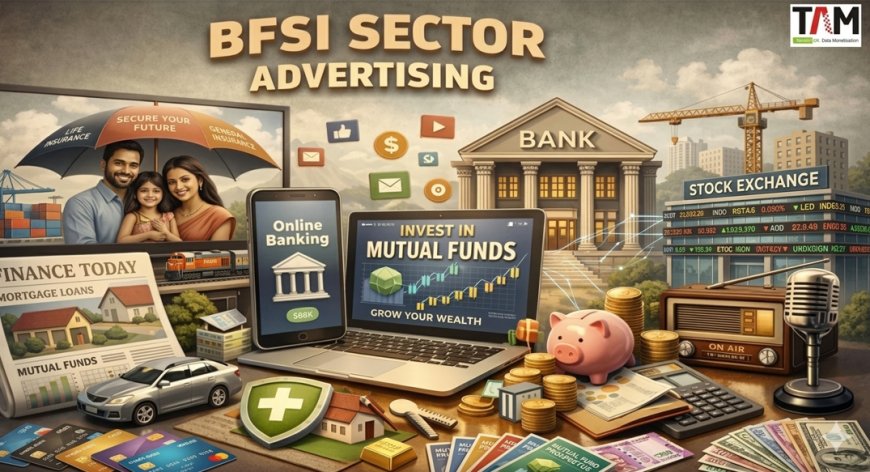
When was the last time a life insurance ad stopped you mid-scroll rather than mid-programme? If your answer leans digital, you are not alone — and the data backs you up. India's banking, financial services and insurance sector, long a dominant force on television and print, is undergoing one of its most significant media strategy shifts in years. The TAM AdEx Cross Media Report 2025 lays out the numbers in sharp detail: digital is surging, television is pulling back, and the entire BFSI advertising ecosystem is moving from mass visibility to precision performance. Here is what the shift means for brands and marketers.
What Just Happened
The TAM AdEx Cross Media Report 2025 reveals a sector in transition. Overall BFSI ad volumes declined 16% in 2025 compared to 2024, yet the longer view tells a more optimistic story — advertising activity is still up 64% when measured against 2021 baseline levels.
Television bore the brunt of the correction. After a strong first quarter, TV ad volumes for BFSI dropped sharply through the middle of the year, with Q2 and Q3 each declining 35% against Q1 levels. Life Insurance led TV spends with a 19% share, followed by Mortgage Loans at 16%. LIC alone held an 11% share of total television ad volumes, and the top ten advertisers collectively commanded 51% of all TV spending — a highly concentrated advertiser base.
Digital told an entirely different story. Ad impressions for BFSI on digital platforms rose from an index of 100 in 2021 to 545 in 2025 — a fivefold increase. Programmatic buying drove 91% of all digital ad transactions, with Banking Services leading at a 27% share of impressions, followed by Life Insurance and Credit Cards at 19% each.
What This Means for Your Brand
For Indian BFSI brands and the agencies managing their media investments, this report is less a data summary and more a strategic directive.
The first implication is channel rebalancing. Legacy brands including major public sector banks and insurance giants have historically leaned on television for reach and credibility — particularly through news channels, which still captured 68% of BFSI TV ad volumes in 2025. That trust association remains valuable. However, the sharp mid-year decline in TV volumes signals that even the most traditional BFSI advertisers are becoming more selective about when and where they commit television budgets.
The second implication is the fintech effect. Newer digital-native players in lending, insurance aggregation and wealth management have built their customer acquisition engines almost entirely on programmatic and performance digital channels. Their success is pulling legacy brands in the same direction. A large private sector bank that once anchored its brand on primetime news slots is now competing with a lending fintech running hyper-targeted loan campaigns on the same smartphone screen.
The third — and most forward-looking — implication is the regional opportunity. Print advertising for BFSI grew a steady 64% since 2021, with the South zone leading regional ad space at 33%. Radio, growing 45% over the same period, showed Maharashtra, Gujarat and Uttar Pradesh as the top three markets. For BFSI brands yet to build deep regional penetration, these mediums remain underutilised and cost-efficient entry points — particularly for vernacular-language campaigns targeting tier-2 and tier-3 audiences.
The contrarian note worth raising: 91% programmatic dominance in digital sounds efficient, but it also signals a commodification risk. When every BFSI brand is buying the same audiences through the same automated pipes, differentiation increasingly comes down to creative quality and offer relevance — not channel access.
The Numbers Behind the News
The TAM AdEx data reveals several patterns that deserve closer attention from media planners.
Print, often written off as a declining medium, demonstrated consistent resilience for BFSI — growing steadily from an index of 100 in 2021 to 164 in 2025. English publications held a 62% share of print ad space, while business and finance titles captured 59%, confirming print's continued relevance for high-involvement financial decision-making among premium audiences.
Radio's 45% growth since 2021 is particularly significant for regional market strategies. Evening and morning slots together accounted for 84% of radio ad volumes, with LIC holding a 20% share — suggesting that state-backed financial brands continue to see strong value in audio formats for mass-market communication.
On digital, Axis Bank emerged as the single largest advertiser with a 12% share of impressions, while the top ten digital advertisers collectively held 59% — a moderately competitive landscape compared to the highly concentrated television environment.
The brands.in Perspective
The TAM AdEx 2025 report is a mirror held up to an industry at a genuine crossroads. BFSI brands that thrived on the credibility of a news channel primetime slot are now being asked to prove performance on a cost-per-acquisition dashboard. Both paradigms have merit — but the brands winning in 2026 and beyond will be those that stop treating digital and traditional as competing budgets and start thinking of them as complementary roles in a single customer journey. Trust is built on television and print. Transactions happen on digital. The smartest BFSI marketers are already engineering for both simultaneously.
Key Takeaways for Marketers
- BFSI digital ad impressions grew fivefold between 2021 and 2025
- Programmatic buying now accounts for 91% of all BFSI digital ad transactions
- Television ad volumes declined 16% year-on-year in 2025 despite long-term growth
- Print grew 64% since 2021, led by English and business publications
- Radio offers a cost-efficient regional amplification channel, up 45% since 2021
FAQ
Q: Which BFSI category spent the most on digital advertising in 2025? Banking Services led digital ad impressions with a 27% share, followed by Life Insurance and Credit Cards at 19% each. Axis Bank was the single largest digital advertiser in the BFSI sector with a 12% share of total impressions.
Q: Is television still relevant for BFSI advertising in India? Yes, but its role is becoming more selective. News channels still captured 68% of BFSI TV ad volumes in 2025, making them valuable for trust-led brand communication — particularly for insurance and banking categories targeting older, high-income audiences.
Q: What does programmatic dominance mean for smaller BFSI brands? Programmatic buying lowers the barrier to entry for digital advertising, allowing smaller fintech and insurance brands to compete for the same audiences as large incumbents. However, with 91% of transactions automated, creative quality and targeting precision become the primary competitive differentiators.
Closing
India's BFSI sector is no longer advertising the way it did even three years ago — and the pace of change is only accelerating. As digital becomes the primary engine for customer acquisition and traditional media narrows its role to trust and brand-building, which medium do you think still delivers the strongest return for financial services brands in India? Share your view in the comments, and follow brands.in every day for the data-driven brand intelligence that keeps you ahead of the market.
What's Your Reaction?
 Like
0
Like
0
 Dislike
0
Dislike
0
 Love
0
Love
0
 Funny
0
Funny
0
 Angry
0
Angry
0
 Sad
0
Sad
0
 Wow
0
Wow
0