



































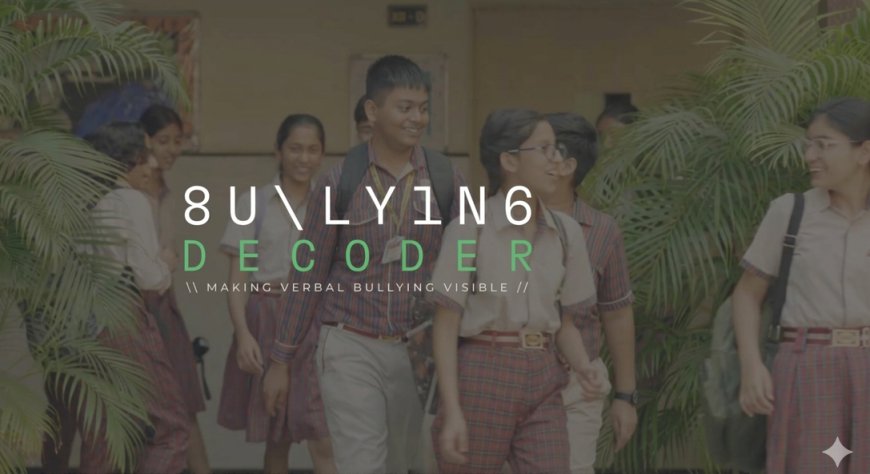
Bullying Decoder: How AI Is Making Verbal Bullying Visible in Indian Classrooms
Dentsu Lab and D.A.V. School launch Bullying Decoder, an AI tool using CCTV audio to detect verbal bullying. Here is what it means for Indian brands and ed-tech innovation.

Introduction
Every Indian school has CCTV cameras. Almost none of them are listening. While visual surveillance has been mandated across school corridors and classrooms for years, the audio feeds attached to those same cameras have sat dormant — unused, unmonitored, and full of untapped insight. Meanwhile, verbal bullying — body shaming, exclusionary language, emotional aggression — continues to quietly damage student wellbeing in ways that no camera angle can capture. A new AI-powered initiative is changing that, and it could reshape how Indian schools approach student safety at scale.
What Just Happened
Dentsu Lab, D.A.V. Public School, and Classteacher Learning Systems have jointly launched Bullying Decoder — an artificial intelligence solution that repurposes existing, underutilised CCTV audio infrastructure in schools to detect and analyse patterns of verbal bullying in real time.
The initiative addresses a long-standing gap in school safety frameworks. CBSE mandates CCTV installation across affiliated schools, but the focus has historically remained on visual monitoring. Verbal bullying — which research consistently identifies as one of the most psychologically damaging forms of peer aggression — has remained largely invisible to school administrators because it leaves no visual trace.
Bullying Decoder activates the ambient audio feeds already present in school CCTV systems and applies AI analysis to detect emotional tone, conversational intensity, and repetition patterns. Critically, the system does not store individual voice recordings or identify specific students. Instead, it aggregates behavioural data into an anonymised sentiment dashboard accessible only to school principals and counsellors.
The rollout is underway across D.A.V.'s network of over 1,000 branches — making it one of the largest deployments of AI-led behavioural science in Indian education to date.
What This Means for Your Brand
This story matters well beyond the education sector. For marketers, brand strategists, and innovation leads, Bullying Decoder is a masterclass in purposeful technology deployment — and it carries several lessons worth internalising.
Repurposing over rebuilding. The most compelling aspect of this solution is not the AI itself — it is the decision to activate infrastructure that already existed rather than build something new from scratch. For Indian brands constrained by budget or scale, this principle is directly applicable: before investing in new tools, audit what you already own.
Privacy-first design as a brand asset. The developers made a deliberate choice to anonymise all data and restrict dashboard access to senior school staff. In an era where consumer and institutional trust in AI is fragile — especially in sensitive environments like schools — this design decision is not just ethical, it is strategically smart. Brands building AI-powered products for Indian consumers should take note.
The shift from reactive to proactive. Bullying Decoder enables counsellors to design grade-specific, context-aware interventions rather than generic assemblies. This mirrors a broader shift in Indian marketing too — from campaign-level mass messaging to behavioural insight-led, audience-specific communication.
The contrarian concern worth raising: as AI enters emotionally sensitive school environments, the governance frameworks around its use must evolve in parallel. Who audits the algorithm? How are false positives handled? These questions deserve clear answers as the solution scales.
The Numbers Behind the News
India's school system serves over 250 million children — one of the largest education populations in the world. Within this system, verbal and psychological bullying remains chronically underreported. Studies across Indian urban schools consistently find that a significant proportion of students experience some form of peer verbal aggression, yet fewer than one in five incidents are formally reported to school authorities.
The AI in education market in India is projected to grow at a compound annual rate of over 40% through 2027, driven by government digitisation initiatives and increasing institutional adoption of ed-tech solutions. Dentsu Lab's entry into this space with a behavioural science application — rather than a learning outcomes tool — marks a meaningful expansion of what AI-in-education can mean in the Indian context.
Early results from D.A.V. schools during the 2025–2026 academic session indicate measurable positive shifts in classroom interactions, with reported increases in peer sensitivity and awareness around respectful communication.
The brands.in Perspective
What Dentsu Lab has built here is not just a school safety tool — it is a proof of concept for human-centred AI in institutional India. The most interesting creative and strategic work of the next decade will not come from building entirely new platforms. It will come from finding intelligence in the infrastructure we already have and asking better questions of it.
For India's marketing and innovation community, Bullying Decoder should prompt a simple but powerful question: what data are you sitting on that you have never thought to listen to? The answer might be more valuable than anything you are planning to build from scratch.
Key Takeaways for Marketers
- AI can activate existing infrastructure — not just create new ones — to solve real problems
- Privacy-first design builds institutional trust, especially in sensitive environments
- Behavioural pattern mapping enables targeted intervention over generic responses
- India's AI-in-education market is growing at 40-plus percent annually through 2027
- Verbal bullying remains a blind spot in Indian schools — Bullying Decoder directly addresses this
FAQ
Q: What exactly does Bullying Decoder do and how does it protect student privacy? It analyses audio from existing school CCTV systems using AI to detect patterns of verbal bullying — tone, intensity, and repetition. No individual voices are recorded or stored. The system generates anonymised, aggregated insights on a secure dashboard accessible only to principals and counsellors.
Q: How is this different from standard CCTV monitoring in schools? Standard CCTV monitoring is visual only and passive — it captures footage for review after an incident. Bullying Decoder activates the audio layer to proactively identify behavioural patterns in real time, enabling early intervention rather than reactive punishment.
Q: Can this solution be adopted by schools outside the D.A.V. network? The solution is built to work with standard CCTV infrastructure already mandated by CBSE across affiliated schools, making it technically scalable to any school with existing camera installations. Broader rollout beyond the D.A.V. network has not yet been confirmed publicly.
Closing
If AI can make verbal bullying visible in a classroom, what other invisible problems in Indian institutions are waiting for the right question to be asked? Share your perspective below — and follow brands.in for daily brand intelligence at the intersection of technology, marketing, and culture.
What's Your Reaction?
 Like
0
Like
0
 Dislike
0
Dislike
0
 Love
0
Love
0
 Funny
0
Funny
0
 Angry
0
Angry
0
 Sad
0
Sad
0
 Wow
0
Wow
0