


































West Asia Conflict Is Changing How Indians Shop, Spend, and Save — Ipsos Data Reveals
Ipsos India's Consumer Pulse reveals 80% of Indians are tracking the West Asia conflict, with major implications for spending, savings, and brand expectations in 2026.

Introduction
When a conflict unfolds thousands of kilometres away, most assume its impact stays there. India's consumers are thinking differently. A fresh wave of data from Ipsos India's newly launched Consumer Pulse tracker reveals that the West Asia conflict is not a distant news story for Indian households — it is a live economic anxiety playing out in grocery lists, fuel budgets, and deferred holiday plans. For brands operating in India right now, this data is not background noise. It is a direct signal about where consumer minds — and wallets — are headed.
What Just Happened
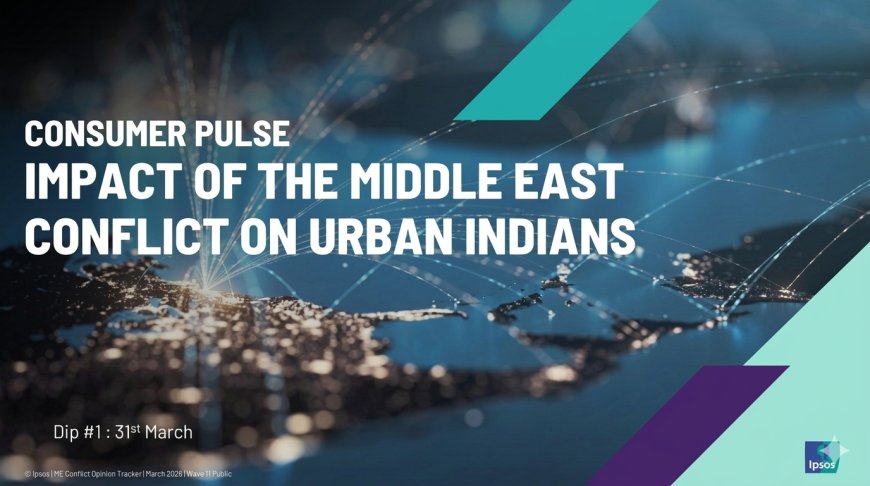
Ipsos India has released the inaugural wave of its Consumer Pulse, a monthly sentiment tracker specifically designed to monitor how the West Asia conflict is influencing consumer behaviour across Indian households.
The findings are striking in their scale. Four out of five Indians are actively following developments related to the conflict, while nearly as many — seventy-seven percent — have expressed serious concern about its potential consequences for India. The connection consumers are drawing is not abstract. India depends heavily on the Strait of Hormuz for a significant portion of its energy imports, making disruptions in that region directly relevant to domestic fuel and LPG prices.
The survey covered eight hundred respondents spanning metro cities, Tier 1, and Tier 2 and 3 towns, with equal gender representation and coverage across income segments — giving the data strong cross-market validity.
What This Means for Your Brand
The Ipsos findings carry immediate and specific implications for brands across categories — and the window to respond thoughtfully is narrow.
Essential categories are under a microscope. Consumers are most anxious about LPG availability, cooking gas prices, and fuel costs. Brands in energy, FMCG staples, and household essentials are operating in a high-scrutiny environment where pricing decisions and supply communication will be watched closely.
Discretionary categories face a real slowdown. Nine in ten consumers anticipate price increases — and in response, they are pulling back on travel, dining out, lifestyle purchases, and large appliances. For brands in these segments, the challenge is not just awareness or preference. It is justifying the spend at a moment when households are actively building financial buffers.
The stocking-up behaviour creates both opportunity and risk. Two-thirds of consumers say they are stockpiling essentials in anticipation of supply disruptions. Brands that ensure consistent availability and transparent pricing will earn genuine loyalty during this period. Those that are perceived as exploiting scarcity — even unintentionally — risk lasting reputational damage.
The contrarian view: brands that lean into value-led positioning now, rather than waiting for sentiment to recover, will be far better placed when consumer confidence returns.
Expert Take
Suresh Ramalingam, CEO of Ipsos India, framed the findings with clarity: what is currently visible is an early but meaningful shift toward caution, with Indian consumers actively reassessing their spending priorities in real time. He further noted that while India has taken deliberate steps to diversify its energy sourcing in recent years, a prolonged conflict in West Asia could sustain upward pressure on input costs across multiple sectors — making brand responsiveness not a choice but a necessity.
The data also surfaces a clear expectation gap between consumers and companies. A strong majority of respondents want brands to prioritise price stability, ensure product availability, and communicate transparently about supply conditions. Affordability-led offerings are no longer a value-segment strategy — they are becoming mainstream expectations across income groups. For marketing leaders, this is a direct brief: relevance and responsibility are the twin mandates for the months ahead.
The brands.in Perspective
India's consumer market has navigated disruptions before — demonetisation, the pandemic, supply chain shocks. Each time, brands that communicated honestly and priced fairly emerged with stronger consumer relationships than those that stayed silent or opportunistic. The Ipsos Consumer Pulse data is essentially handing brand teams a live playbook. The question is not whether consumer sentiment is shifting — it clearly is. The question is whether Indian brands will respond with the kind of grounded, empathetic communication that this moment demands, or whether they will default to business-as-usual messaging that consumers will see straight through.
Key Takeaways for Marketers
- Eighty percent of Indians are actively tracking the West Asia conflict, with direct implications for domestic spending behaviour
- Nine in ten consumers expect price increases, driving a measurable shift away from discretionary spending
- Two-thirds of households are stocking up on essentials — creating both a demand surge and a brand trust test
- Consumers expect brands to prioritise price stability, availability, and transparent communication during this period
- Value-led and affordability-focused brand positioning is becoming a cross-segment expectation, not just a budget-market strategy
FAQ Section
Why are Indian consumers worried about a conflict in West Asia? India relies on the Strait of Hormuz for a significant share of its energy imports. Any disruption in that region has a direct impact on domestic fuel prices, LPG availability, and broader inflation — making the conflict economically relevant to everyday Indian households.
How is the West Asia conflict affecting consumer spending in India? Consumers are cutting back on discretionary purchases like travel, dining, and lifestyle products while prioritising essential spending. Many are also stocking up on staples and cooking fuel as a precautionary measure against potential supply disruptions.
What do Indian consumers expect from brands during this period? Consumers expect brands to maintain price stability, ensure product availability, and communicate honestly about supply conditions. Affordability and value-led offerings have become critical expectations across income groups.
Closing
Consumer sentiment in India is shifting — quietly but decisively. The brands that listen to these signals now, rather than after the headlines have moved on, will be the ones consumers remember when confidence returns. How is your brand responding to the current economic mood across Indian households? Join the conversation below and follow brands.in for daily data-led insights on Indian consumer behaviour, brand strategy, and marketing intelligence.
What's Your Reaction?
 Like
0
Like
0
 Dislike
0
Dislike
0
 Love
0
Love
0
 Funny
0
Funny
0
 Angry
0
Angry
0
 Sad
0
Sad
0
 Wow
0
Wow
0