




















Coca-Cola's 'Halftime' Campaign With Diljit and Janhvi Finds Magic in Everyday Pauses
Coca-Cola India's Halftime campaign with Diljit Dosanjh and Janhvi Kapoor redefines everyday breaks as moments of reconnection. Here's what Indian marketers can learn from it.

Introduction
In a country that runs at full throttle — juggling deadlines, family obligations, social media, and the general noise of modern Indian life — the most powerful thing a brand can offer is permission to pause. Coca-Cola has built its latest campaign around exactly that idea. Not a grand escape, not a lifestyle aspiration, but something far more honest: the small, in-between moment when you surface from autopilot and actually notice the world around you. With Diljit Dosanjh and Janhvi Kapoor as its storytellers, Coca-Cola India has launched one of this season's most emotionally intelligent campaigns.
The Big Announcement
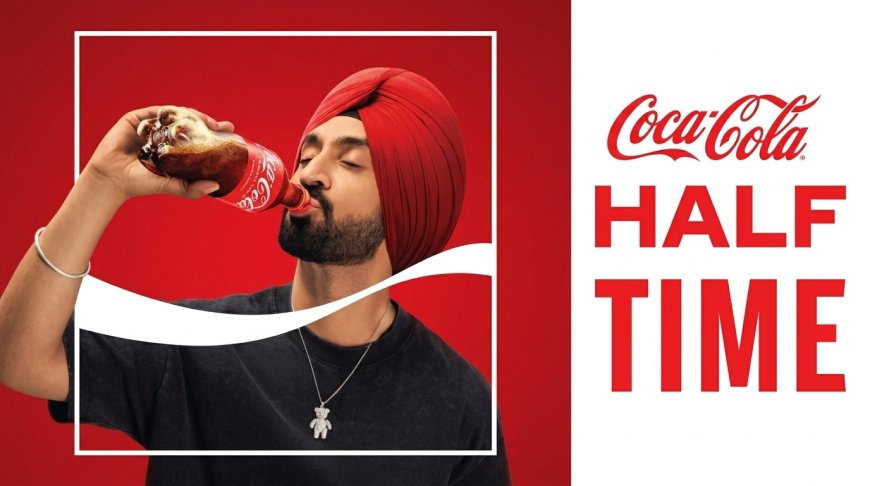
Coca-Cola India has unveiled its new campaign built around the concept of a 'Coca-Cola Halftime' — a repositioning of the everyday break as a moment of genuine reconnection rather than mere rest. The campaign features two of India's most culturally resonant stars: Diljit Dosanjh, whose pan-India appeal cuts across language and geography, and Janhvi Kapoor, who connects strongly with younger urban audiences.
Conceptualised by WPP Open X, led by VML, the campaign films capture what the creative team describes as 'in-between' moments — those stretches of the day when people are physically present but mentally elsewhere. Diljit is shown caught in the rhythm of a rehearsal, and Janhvi immersed in her own thoughts during a casual hangout. In both scenarios, a single sip of Coca-Cola acts as the reset — snapping them back into the present and transforming a checked-out moment into something alive and warm.
The campaign rolls out across Delhi, Punjab, Uttar Pradesh, Maharashtra, Tamil Nadu, and Karnataka, with market-specific film adaptations and an original soundtrack composed by Donn Bhat, featuring vocals by Vivek Hariharan and Aarifah Rebello.
What This Means for Your Brand
The strategic architecture of this campaign holds important lessons for marketers across categories — not just beverages.
Coca-Cola has deliberately moved away from occasion-based advertising, where the product appears at parties, celebrations, or peak summer moments. Instead, the brand is planting itself in the unglamorous middle of the day — the rehearsal break, the distracted hangout, the quiet lull between tasks. This is a significant shift in brand positioning, and it opens up far more touchpoints for relevance.
For Indian brands watching this move, the implication is clear: the battleground for consumer attention is no longer the peak moment. It is the in-between. The commute, the desk stretch, the mid-afternoon slump. Brands that can authentically own these micro-moments build a far stickier emotional relationship than those chasing only celebrations and milestones.
The multi-market localisation strategy is equally instructive. By deploying Diljit Dosanjh across Hindi-belt markets and Janhvi Kapoor in Tamil and Kannada adaptations, Coca-Cola demonstrates that true national reach in India requires cultural specificity, not just translation. A single pan-India film would have been easier and cheaper — but it would have been blunter.
The forward-looking challenge: as more brands chase the 'mindfulness' and 'presence' narrative, Coca-Cola will need to defend this emotional territory with consistency across all consumer touchpoints, not just campaign films.
Expert Take
The insight driving this campaign reflects a broader behavioural shift that research has consistently flagged in post-pandemic India. Consumers report feeling simultaneously more connected — through devices and platforms — and more mentally scattered. The desire for presence, for being genuinely in the moment, has become one of the dominant emotional undercurrents of urban Indian life.
Karthik Subramanian, Senior Director of Marketing at Coca-Cola India and Southwest Asia, framed the campaign's foundation around this truth: today's consumers are navigating fuller, faster lives, and what they increasingly value are small, meaningful breaks that keep them grounded in the moment.
Nakul Sharma and Tirtha Ghosh, Executive Creative Directors at VML, added another dimension to the creative rationale — that Coca-Cola is being positioned not as a drink but as a micro-moment of reconnection, a simple beat that helps you return to the present. The addition of a retro-inflected original soundtrack further anchors the campaign in warmth and memory, giving it a sensory layer that extends well beyond the visual.
The brands.in Perspective
Celebrity campaigns in India often fall into a familiar trap: the star overshadows the idea. What Coca-Cola and VML have done here is use their celebrity choices as cultural shorthand rather than spectacle. Diljit Dosanjh does not need to perform energy — he embodies it. Janhvi Kapoor does not need to perform relatability — her generation lives the distraction the campaign describes. The casting is the insight. Add to that a musically distinctive soundtrack and genuine market-level localisation, and this campaign earns its place as a benchmark for how large FMCG brands should operate in a diverse, attention-fragmented market like India.
Key Takeaways for Marketers
- Coca-Cola India repositions everyday breaks as meaningful 'Halftime' moments of reconnection
- Campaign features Diljit Dosanjh and Janhvi Kapoor across six key Indian markets
- Conceptualised by WPP Open X led by VML with market-specific film adaptations
- Original soundtrack by Donn Bhat adds a retro sonic identity to the campaign
- Strategy shifts from occasion-based to micro-moment brand positioning
FAQ
Q: What is the central idea behind Coca-Cola's Halftime campaign? The campaign repositions a simple Coca-Cola break as a moment that pulls you back into the present — from autopilot to awareness. It targets the in-between moments of daily life where people are physically present but mentally elsewhere.
Q: Why were Diljit Dosanjh and Janhvi Kapoor chosen for this campaign? Both stars bring distinct cultural relevance to specific markets. Diljit connects deeply with audiences across Delhi, Punjab, Uttar Pradesh, and Maharashtra, while Janhvi features in Tamil and Kannada adaptations, enabling genuine regional storytelling rather than a one-size-fits-all approach.
Q: Who conceptualised the Coca-Cola Halftime campaign? The campaign was conceptualised by WPP Open X, led by VML, with Executive Creative Directors Nakul Sharma and Tirtha Ghosh leading the creative direction.
Closing
Coca-Cola has reminded Indian marketers that the most powerful brand moments are not always the loudest ones. Sometimes, it is the quiet pause between everything else that carries the most meaning. Which brand in your category is best positioned to own India's in-between moments — and is yours one of them?
Share your perspective below, and follow brands.in for daily intelligence on the campaigns, brands, and creative strategies defining Indian marketing.
What's Your Reaction?
 Like
0
Like
0
 Dislike
0
Dislike
0
 Love
0
Love
0
 Funny
0
Funny
0
 Angry
0
Angry
0
 Sad
0
Sad
0
 Wow
0
Wow
0